Deprecated: Creation of dynamic property FusionSC_Column::$is_nested is deprecated in /var/www/test/ffj-wp/public/wp-content/plugins/fusion-builder/inc/class-fusion-column-element.php on line 553
Deprecated: Creation of dynamic property FusionSC_FusionText::$params is deprecated in /var/www/test/ffj-wp/public/wp-content/plugins/fusion-builder/shortcodes/fusion-text.php on line 127
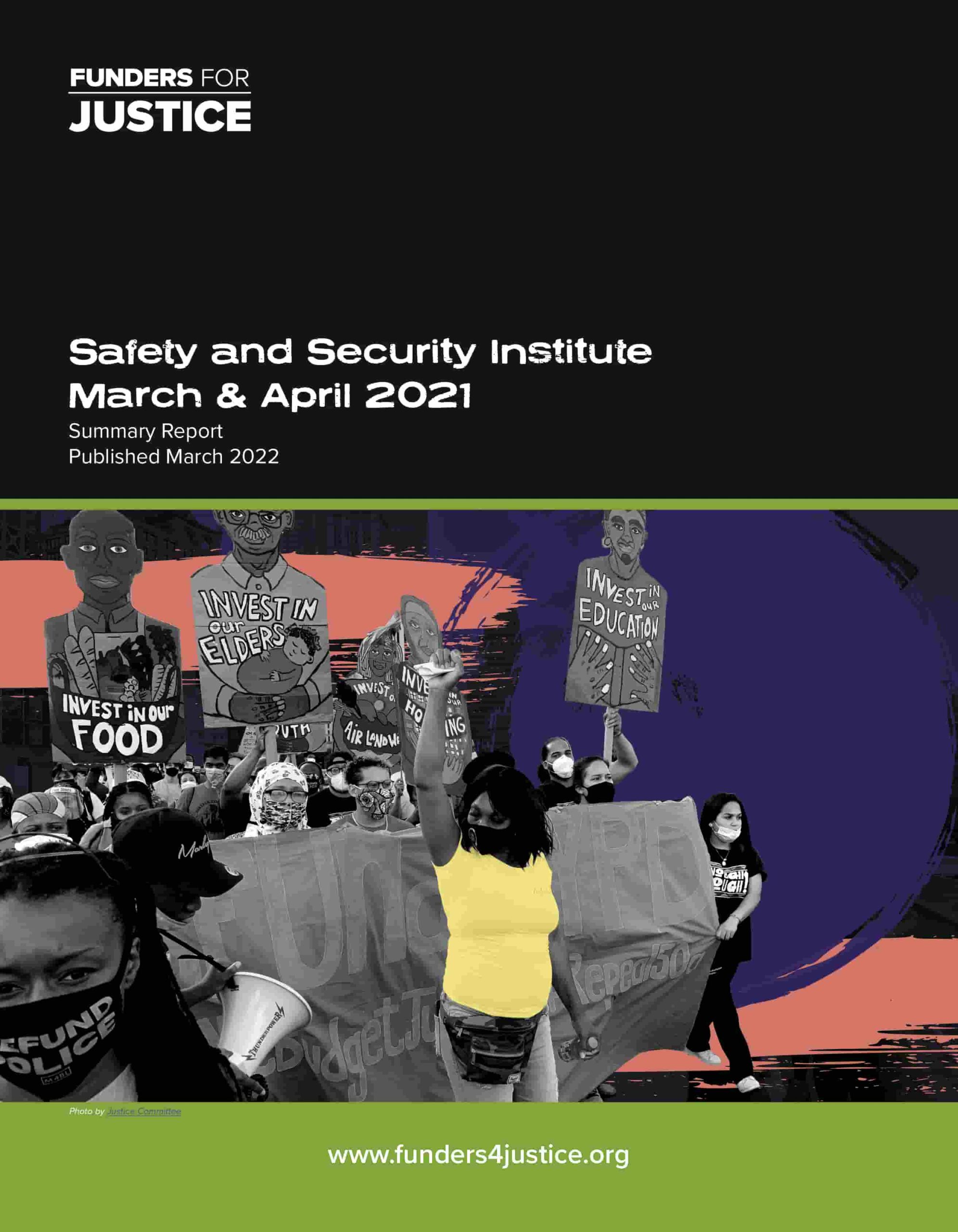
Published March 2022
FFJ offers this summary report on the strategies and approaches that various movement actors are taking as they respond to safety and security concerns. It is our hope that this summary serves as a building block and resource to advance our collective learning and work on safety and security.
Table of Contents
Part I. Introduction & Goals
Part II. Session Briefs with Recommendations to Funders
- Session 1. History, Context & Defining Safety & Security
- Session 2. State Threats, Technology & Surveillance Capitalism, and White Supremacy & White Nationalists
- Session 3. The Far Right and White Nationalists
- Session 4. We Keep Us Safe! Community Defense Strategies, Part 1 (Healing Justice, Copwatch, Gendered Islamophobia, & Alternatives to Calling 911)
- Session 5. We Keep Us Safe! Community Defense Strategies, Part 2 (Digital Security & Movement Tech, Cultural & Arts Strategies, & Capacity Builders)
- Session 6. Movement and Foundation Relationships
Part III. Top Recommendations for Funders
Download the Report
To download the report, click here, or click on the report image below. You will be taken to another page and asked for a password. Please email us at info@funders4justice.org for the password.
Interested in viewing recordings of the institute sessions? Contact us at info@funders4justice.org. Please note there is a fee for those who did not register for the original event. Those who registered will receive free access to the videos.
The post Safety & Security Institute Report first appeared on Funders for Justice.
]]>
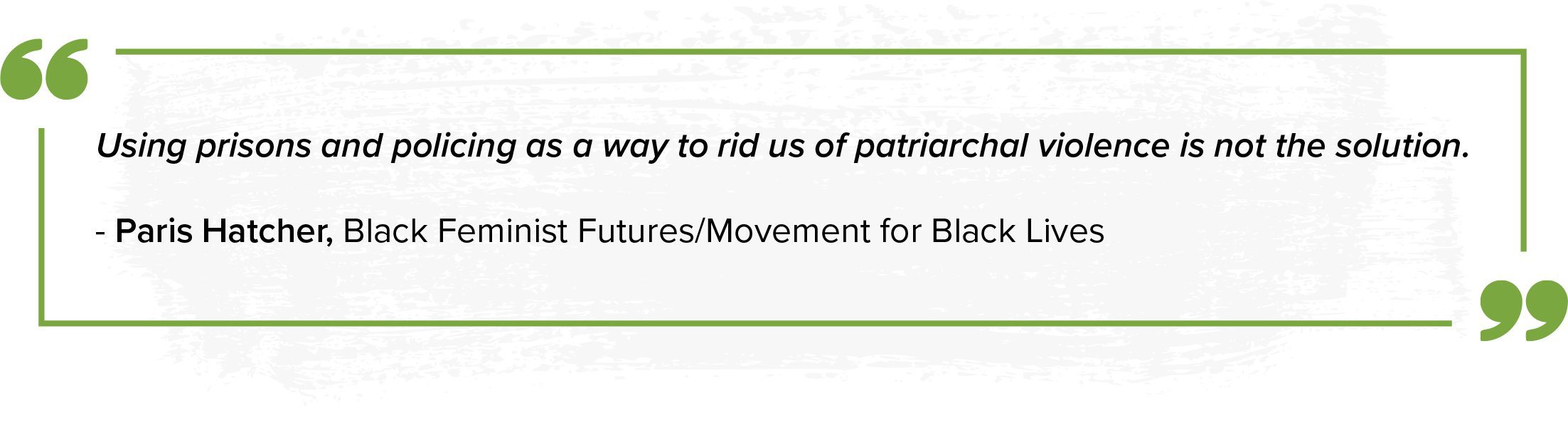
In September 2020, Funders for Justice hosted the three-day institute, “Eradicating Gender-Based Violence Outside of the Carceral System.” This institute, which featured some of the field’s most prominent experts, focused on elevating the dynamics and solutions for how we combat gender-based violence without reliance on policing in all its forms. The speakers also addressed, specifically, the role that funders and philanthropy have to play in supporting the organizations and leaders working tirelessly – and often without the necessary resources – to tackle these complex issues while supporting their communities.
Download the Report
To download the report, click here, or click on the report image below. You will be taken to another page and asked for a password. Please email us at info@funders4justice.org for the password.
View the Institute Videos
For the link and password to access to the full videos of this institute, please email us at info@funders4justice.org. Funders who registered and attended the institute will be given access to the video recordings for no additional cost. If you did not participate and would like to watch the videos, please email us to require about the fee and password.
View Clips from Each of the Sessions
Session One
Session Two
Session Three
The post Eradicating Gender-Based Violence Report first appeared on Funders for Justice.
]]>Deprecated: Creation of dynamic property FusionSC_Person::$base_selector is deprecated in /var/www/test/ffj-wp/public/wp-content/plugins/fusion-builder/shortcodes/fusion-person.php on line 732
Deprecated: Creation of dynamic property FusionSC_Person::$dynamic_css is deprecated in /var/www/test/ffj-wp/public/wp-content/plugins/fusion-builder/shortcodes/fusion-person.php on line 733


By Maisha Quint, Libra Foundation; Cindy Alvarado, The Simmons Foundation; Claribel Vidal, Ford Foundation, members of FFJ’s Healing Justice Strategy Group
July 16, 2020
As we witness the ongoing health and economic crisis of the pandemic of COVID-19, and the simultaneous murders and violence by the state and White nationalists, and the glaring role of ableism in our nation, we must recognize that our country is being forced to reckon with the structural racism that has pervaded this country since its inception. How we, as funders, respond in this critical moment will have a significant and long-term impact on communities most affected by the multiple crises we are living through today.
Right now, many in the philanthropic sector have reacted by turning to their grantee partners to ask how these acute moments impact the communities they serve, their work, and the urgent needs that have arisen. And while organizations and movement leaders are exercising great ingenuity, commitment, and resilience, they’re also telling us that this moment presents a new set of obstacles for them to navigate. As our funder colleagues consider how to responsibly and effectively respond and provide support during this time, we ask you to please take a moment to ask yourself these guiding questions:
1) How has working during this public health crisis and violence on Black bodies impacted your own productivity, focus, and mental health?
2) Understanding that many of our grantee partners have already been working in crisis mode, what would it look like for philanthropy to holistically support the capacity of the organizations and the people that run them NOW, and also in the long-term?
This is where “healing justice” enters into our conversation as a necessary frame for funders. Defined in the Astraea Foundation’s report Healing Justice: Building Power, Transforming Movements, “Healing justice work (is about the) — resiliency and survival practices that center the collective safety and wellbeing of communities — as an integral part of our fight for collective liberation” (2017). If we as funders recognize the importance of the sustainability of our grantee partners, the capacity of the frontline groups fighting for equity, and especially of organizations whose leadership and staff represent those that are most marginalized and oppressed, then our grant-making must represent these values. It must reflect our understanding of the impact that the traumas of white supremacy, capitalism, and patriarchy have on communities and individuals. Resourcing and integrating healing justice within grant-making and organizational practices is about carrying out values of equity and liberation. Philanthropies that are resourcing healing justice can speak to organizations that in the midst of crisis have created bold, impactful, and people-centered solutions. Imagine if we funded the holistic sustainability and wellness of grantee partners so that they had the capacity to innovate, shift, and resist. It is also important to remember that while you might start or increase funding due to the pandemic, groups need funding over the long-term. The world has radically changed and will continue to radically change. To further collective understanding of what healing justice grant-making is, we have outlined examples of how some colleagues are approaching this work. We also invite you to contact us to discuss what it can look like within your organization.
What We’re Funding
Based on the framework and concepts offered above, it is important to reflect upon the types of projects and/or organizations to fund. The following are some key considerations as you determine your approach to funding healing justice:
Organizing is Deeply Connected to Healing
While the term “healing justice” has gained traction over the last 15 years, the practice of healing — providing support and tending to individuals and communities who have endured trauma due to white supremacy and structural racism — has existed for generations. In fact, participation in organizing and movement-building is and has historically been a key part of the healing process. Groups such as the Black Panthers, as well as the American Indian and the Chicano movements, organized for self-determination and the liberation of their communities. Their organizing created a sense of hope and vision for a world that is possible.
There is an increased interest in funding grassroots organizing and movement building efforts across the country. Oftentimes, organizers have been resourced to achieve policy win after policy win with little regard for the toll that this work takes on individual organizers and entire organizations. Many grassroots organizations are led and staffed by people who have survived the very systems they seek to dismantle. It is common to be triggered by a confrontation with police or hearing from a mother whose child died while in jail, prison, or immigrant detention centers. If funders intend on supporting successful and sustainable movements, funding healing practices is necessary.
Healing justice cannot be prescriptive. Healing practices are unique to each community and organization. For example, Urban Peace Movement, an Oakland-based non-profit organization, is dedicated to building youth leadership in the city of Oakland “to transform the culture and social conditions that lead to community violence and mass incarceration.” The organization has developed a community-specific, healing-informed organizing model that supports its youth leaders to feel self-confident and hopeful while empowering them to work toward social justice. They have also developed creative ways of offering healing support to their community via events such as Scratch and Fade. This event provides community members with haircuts and nail services while also offering one-on-one counseling, health screenings, and elder blessings in the same location. Dignity and Power Now (DPN) is a Los Angeles-based grassroots organization fighting to achieve transformative justice and healing for all incarcerated people, their families, and their communities. DPN offers rapid response support to families who have had family members die in jails or as a result of other incidents of state violence. They also offer wellness clinics outside of Los Angeles County jails to support family members after jail visits. Not only is this an opportunity to console family members, but the information has helped to inform new campaigns. These are two examples of what resourcing healing-informed organizing can look like in practice, and there are an abundance of other examples in communities across the country. We encourage you to research on your own and connect with other funders who have experience funding this work.
Building a Community of Healers
While there may be organizations who have an existing healing practice, there are others who are interested in learning about incorporating healing approaches into their work but need technical support. Supporting an organization to participate in their own healing journey can be a great opportunity for your foundation’s own learning. The Heising-Simons Foundation offered organizational effectiveness support to Safe Return Project, a grassroots organization in Richmond, California, interested in incorporating healing-informed practices throughout the organization (i.e., Human Resources to Organizing). The organization had already identified the healing consultant they wanted to work with and simply needed the resources to compensate them. Heising-Simons recognized the value of implementing healing-informed practices to the sustainability of this organization’s work and its contribution to the movement in general. This grant also enabled Heising-Simons staff to learn alongside its grantee partner.
As mentioned previously, many grassroots organizations are led and staffed by system-impacted people. Their organizations are deeply rooted in some of the most disenfranchised communities and therefore are often directly impacted when incidents of violence or other community harm occurs. There have been countless stories of organizations who have had members violently murdered and whose leaders are also in need of healing. Often, these organizations call upon their elders to provide support in times of crisis. Committed to supporting their communities, these healers respond and are often rarely compensated. This is one example of how philanthropic resources can support healing in grassroots organizations. It might be helpful to ask current or potential grantee partners if they have a healing-informed practice. If so, who do they work with and how is this work supported? If not, you might ask if this is work the organization might be interested in. You may also consider providing funding to organizations who offer capacity building focused on healing approaches.
Funding to Learn
Like with any new grantmaking, a great way to learn about a variety of healing approaches is to support pooled funding opportunities. Pooled funding allows funders to learn about a variety of healing approaches while also supporting critical work. Funders that fully and powerfully integrate a healing justice funding practice include Third Wave, Astraea, Groundswell, Urgent Action Fund, and Akonadi Foundation. The Andrus Family Fund, Libra Foundation, RISE Together Fund, Four Freedoms Fund, and John M. Lloyd Foundation have also been learning while doing. A great example of pooled funding is the Next Generation Fund through the Ford Foundation which serves as a learning initiative at the intersection of youth organizing, social change, resilience, and healing.
How To Incorporate a Healing Justice Lens Into Grant-making
In addition to what we fund, how we fund is critical to ensuring that we are mobilizing resources and being responsive while minimizing harm to communities. Below you can find guidelines for how to center healing throughout your grant-making processes.
Acknowledge who carries the risk. Philanthropy plays a role in perpetuating the trauma and risk communities experience. When we talk about the accumulated wealth foundations have, most of that wealth stems from the stolen labor and land of Black, Indigenous, and People of Color (BIPOC) communities. Rather than offering reparations, philanthropy continues to operate from a “risk management” perspective that places a heavy burden on nonprofit organizations seeking funding to prove themselves as high quality, effective, financially healthy, and capable organizations. This approach continues to uphold racial disparities, resulting in inequitable funding to organizations led by and for BIPOC communities. A healing justice lens asks us to consider who carries true risk and examine philanthropy’s role in perpetuating that risk. The communities we seek to serve live in a state of constant crisis from the effects and threats of structural and systemic racism, classism, and sexism. These effects are further magnified with COVID-19, as we have witnessed how this pandemic has disproportionately impacted BIPOC, disabled, immigrant, and low-income communities. As frontline organizations seek to hold space for healing, services, and organizing in their communities, philanthropy must forgo its risk management approach and lead with trust and the recognition that philanthropy’s wealth comes from extracted resources and stolen labor, bodies, and land.
Trust in the people. Trust that small, grassroots organizations led by and for those most directly impacted are the leaders with the best solutions for their communities. These organizations have an intimate knowledge of the people, their needs, and local resources and often serve as trusted connectors in the community. As funders seek to plan their long-term COVID-19 response and healing strategies, we must be intentional about listening to those on the ground and honoring their lived expertise.
What does this look like in action?
- Healing is deeply personal and should never be prescribed to grantee partners. Healing practices are unique to each person, organization, and community. Oftentimes, these practices are culturally rooted and deemed sacred, therefore it is important for foundations to avoid prescribing specific healing approaches to organizations.
Andrus Family Fund has recently made a number of grants in this vein, including funding five grantees to embed healing justice in their organization by partnering with Universal Partnership to train and provide coaching to organizations and their leaders, by funding Healing Justice grantee organizations such as Resilient Strategies, or supporting grantees to launch their own journey providing healing justice for the coalition members of the Youth First! Initiative youth table, which support youth impacted by the youth justice system across various states. Andrus also launched a Flexible Care Fund for leaders at organizations to access small grant dollars to access individual healing as they lead organizations and manage teams, with grants ranging from $500 to $3,000, and only requiring an application of 2-3 sentences via email. AFF anticipates funding additional work in 2020, informed by relationships built with field partners as part of the Funders for Justice Healing Justice Strategy Group.
- Match the sense of urgency and deploy all of your resources. Communities are facing urgent needs, and cumbersome grant-making processes with inflexible timelines are not compatible with the reality we are currently operating in. Neither is a 5% payout. Funders must wield our power now, leverage our resources now, and create space for marginalized communities to own their power. We have seen philanthropy take incremental steps that have long been called for, such as streamlining processes and accepting electronic applications; these changes are helpful but not necessarily transformative. As funders, we are tasked with mobilizing resources to communities. How might we be more responsive, bold, and transformative in our actions? This includes moving money specifically to BIPOC communities and LGBTQ and gender expansive communities, increasing your payout, mobilizing your 95% in investments, engaging in community-led grant-making, and implementing a spend down or sunsetting policy.
- Be in it for the long-term. Provide unrestricted multi-year funding so that organizations can move beyond surviving to thriving to reimagining. With the recent economic downturn, we are seeing foundation budgets shrink and wealth preservation take priority to safeguard perpetuity and legacy. This de-prioritization of community runs counter to philanthropy’s intent and causes harm to the organizations we are supposed to be in partnership with. Our nonprofit partners are asking us to show up, yet philanthropy is contracting or worse, being silent. Many nonprofit organizations are facing reduced grant funding and short-term investments. Restrictive, time-limited grants effectively keep organizations in a state of survival mode and limits their growth as they dedicate more time to seeking out grants, reporting, and re-applying. By providing unrestricted, multi-year funding, organizations can feel safer about their longevity and ability to be of service to the community. This feeling of safety allows an organization to move toward visioning and reimagining the kind of world we want to create. In this time of crisis, your solidarity and support, financial and otherwise, will go a long way in enabling those on the frontline to fight for justice with minimal harm to themselves and their loved ones.
- Example organizations: Astraea Lesbian Foundation for Justice, Third Wave Fund, Thousand Currents, Ford Foundation, Langeloth Foundation
- Reconsider how you measure impact, especially as it relates to healing work. As funders, we ask for a lot of data from community, particularly vulnerable populations. We need to acknowledge the institutional racism and oppression in historical and current data collection and analysis that extracts, dehumanizes, and problematizes communities. There is an inherent power imbalance in who is asking the questions versus who is being asked to provide answers and proof through data. As funders, it is within our power to stop asking for data in a way that causes harm or delegitimizes the value of work without data. Data has the potential to be empowering when it is done in a community-centered and -led approach that emphasizes communities’ power in deciding if, when, and how to tell their stories.
- Examples: Astraea Lesbian Foundation for Justice, Third Wave Fund
- Resources: Equitable Evaluation Initiative, Frontline Solutions
- It is also important for funders to share back any data they collect. As more and more foundations are incorporating an equity lens, there are several data points philanthropy can and should be monitoring and sharing to ensure we are making progress and being held accountable. This includes committing to regular grant-making data analysis of:
- Percentage of funding for multi-year grants
- Percentage of funding for general operating support
- Median length of relationship with grant partners
- Percentage of funding by size of organizational budget
- Percentage of funding for organizations led by and for BIPOC, women of color, LGBTQ and gender expansive individuals, and immigrant organizations
- Approach the work with a spirit of humility. Social justice would not be possible without the people on the ground. The work has existed long before philanthropy and will continue to do so. As funders, we help support movements, but we are not the movement. Our primary role is to move money out the door. Our support is needed to ensure that those on the frontlines are well-resourced and well in mind, body, and spirit to carry the work forward. Funders can show support by intentionally lifting up healing in your conversations with grantee partners, letting them know it is something your foundation will support, and respecting people’s right to self-determine what that looks like for them.
- Tap into your funder privilege. As philanthropy, we face substantially less risk in speaking up or advocating for what is needed in comparison to our grantee partners. Additionally, our funder privilege and power offers us access to people, tables, and opportunities others do not have. As we have seen during the pandemic, small, grassroots organizations continue to be overlooked in federal and local relief efforts. There is a need for philanthropic advocacy to demand equitable disaster response and recovery efforts that center these organizations. Likewise, philanthropy must continue to advocate for the inclusion of marginalized populations and strategies that are both culturally responsive and trauma-informed. There is a lot of fear and mistrust from communities that have been actively oppressed and persecuted by systems, institutions, and policies. Our institutional response must center those experiences. We have the privilege of our voices being heard, and we have both the opportunity and responsibility to speak up and create space for those most directly impacted to be heard.
How We’re Working
In addition to funding healing and wellness, the philanthropic sector needs to examine its own institutional cultures. How are you acknowledging and addressing the institutional barriers, micro aggressions, and prejudice your staff experiences, particularly BIPOC staff and those with lived experiences? BIPOC staff often report facing internal tensions about belonging, tokenization, being complicit in a harmful system, and many more factors that make it difficult to show up as their whole selves in a system that was not designed by or for them. Additionally, second hand trauma experienced from what staff see, hear, and learn from the communities they support and identify with can cause feelings of burnout and emotional exhaustion. While it is important for funders to create a supportive culture that prioritizes healing, this work cannot be accomplished without a hard look at the white supremacist cultures that are perpetuated by staff and leadership and a commitment to unlearning that behavior. This might look like engaging in anti-racist and anti-Blackness training with a facilitator, establishing and resourcing employee resource groups, and hosting restorative circles when harm is caused.
Below you can find several examples of how you might incorporate healing into your institution. While these are helpful, we recommend you ask your staff what might be most supportive during this time of crisis.
- Take a look at existing processes. How might you be intentional about dedicating time to checking in and putting relationships before tasks?
- Create new opportunities during the work day. Encourage staff to take time to rest in a manner that resonates with individual staff (e.g., naps, movement, games, meditation sessions, etc.)
- Provide options for self-care and community care. Staff should have the option to decide whether they would like to pursue individual healing practices or collective/team-building activities similar or as part of professional development budgets.
- Lead by example. As institutional leaders, you can start modeling what it looks like to prioritize healing and wholeness. Whether that is creating and taking “mental health days” so that staff can take a needed pause and proactively interrupt burn-out, or modeling a personal practice that you commit to and block off time on your calendar for.
- Prioritize what is truly important. This might be different for everyone, but in a time of crisis, human connection is essential for our survival. Connecting with peers or grant partners might be helpful.
- Dismantle white supremacy culture in your organization. This means noticing, interrupting, and responding differently when perfectionism, a sense of urgency, and hyper-productivity comes up for you or other staff members. Hyper-productivity and focus can also be a sign of a trauma response. This is a sign to lean into the healing practices you’ve cultivated.
Call to Action: Concrete Steps
Here are some concrete next steps that you and your philanthropic institution can take to continue to learn about healing justice, work towards transforming the harmful ways philanthropy has operated, and provide the long-term support communities and our grantee partners need.
- 1) Learn: Connect with funder colleagues who are doing this work by joining the FFJ Healing Justice Strategy Group. Write to us at fundersforjustice@nfg.org.
- 2) Resource healing justice
- Ask your grantee partners how they’re taking care of themselves and their team during this time. What resources do they need? Can you provide some additional funds for this work?
- Connect with the organizations mentioned above to explore potential alignment and partnerships where you can learn by resourcing.
- 3) Commit
- Do not treat healing as a trendy topic in philanthropy or as a one-time venture. Neither individual nor collective healing is linear, especially during these re-traumatizing and newly-traumatizing moments. Healing takes time.
- Bring this topic and/or any of the resources shared in this article to internal staff discussions and share broadly with your funder colleagues.
- Act now. The pandemic and state violence against Black people necessitates action now. As Black communities are at the forefront of protesting for change, the Movement for Black Lives (M4BL) is asking funders and donors to mobilize $50 million in 2020 toward strengthening the national movement infrastructure and its ecosystem of Black-led, Black-facing organizations. As mentioned above, healing is critical for sustainable movements and funders play a key role in offering that support.
The FFJ Healing Justice Strategy Group invites you to get in touch to discuss what this can look like within your organization. If you would like to learn more about these actions, contact us at info@funders4justice.org.
[1] These organizations are being highlighted as examples of how healing is incorporated into their organizing work. There are several other examples throughout the community.
The post Healing Justice Guidance to Philanthropy During COVID-19, the Uprisings, and Beyond first appeared on Funders for Justice.
]]>